Case study /11 · Delivered
Guardian Methodology Digitization
Context
The carbon market's core problem is trust: buyers can't independently verify what a credit represents. Digital MRV (measurement, reporting and verification) attacks that by making the entire evidence chain — from field data to issued credit — machine-checkable. Hedera Guardian is the open-source platform for this: methodologies become policy workflow graphs, data becomes schema-validated verifiable credentials, and verified emission reductions mint as tokens.
Problem
Methodology digitization is a translation problem with zero tolerance for drift. The source documents mix prose, equations, eligibility rules and monitoring requirements designed for expert judgment. Encode them too loosely and the digital policy certifies things the methodology never allowed; too rigidly and legitimate projects can't pass. Every modeling decision had to be defensible against the original text.
Constraints
- Methodology fidelity was absolute: the digital policy must implement the written methodology, not an interpretation of it.
- Multi-role workflows — project proponent, validator/verifier (VVB), standard registry — each with distinct permissions and approval gates.
- Every artifact needed cryptographic provenance: who submitted it, who approved it, against which schema version.
- The Guardian platform itself evolves quickly; policies had to survive version upgrades.
Responsibilities
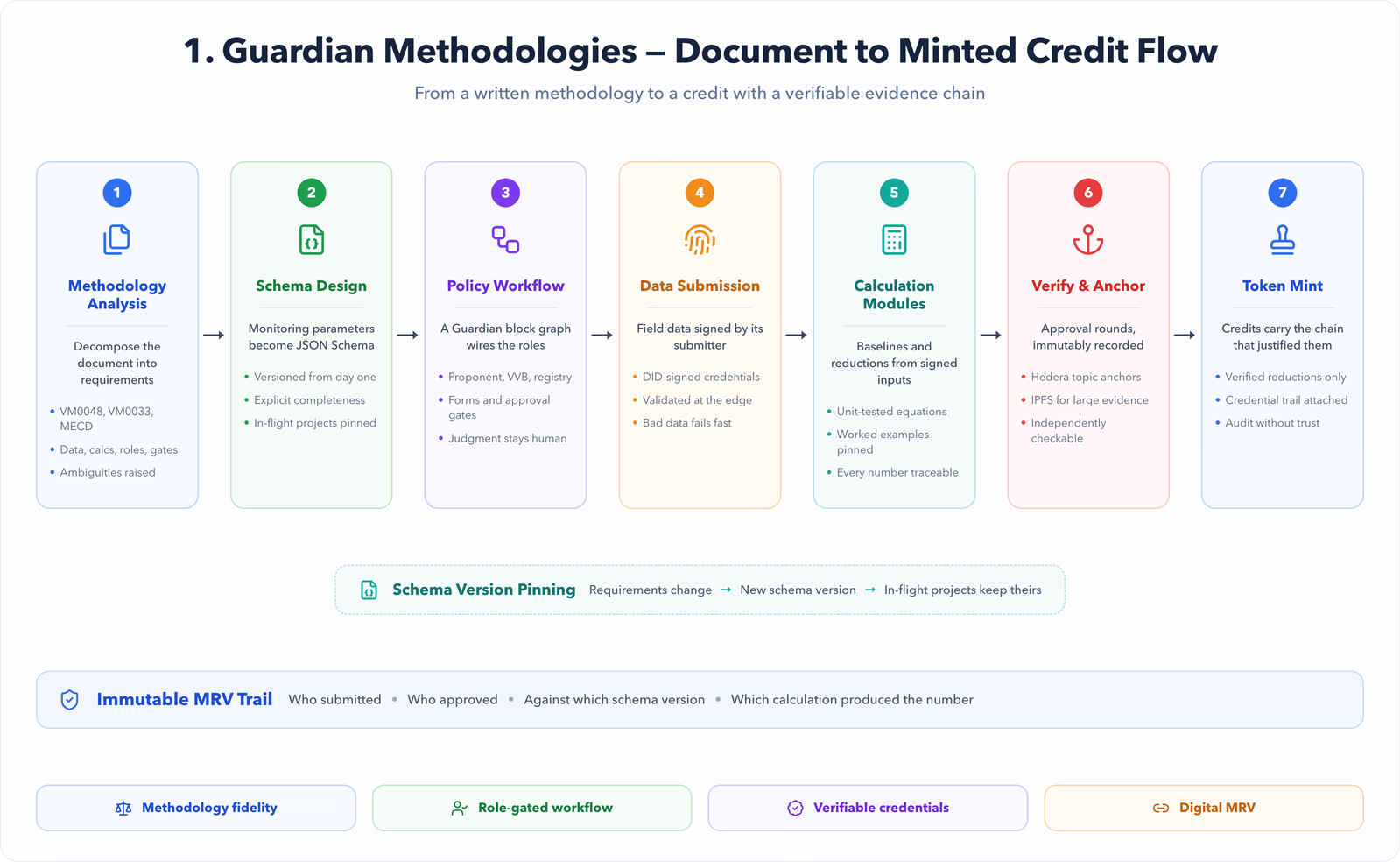
- Methodology analysis: decomposing VM0048, VM0033 and MECD into data requirements, calculations, roles and decision points.
- JSON Schema design for monitoring parameters, project descriptions and verification reports.
- Policy workflow implementation in Guardian — block graphs wiring roles, forms, approvals and calculations.
- Calculation modules for baselines, emission reductions and uncertainty deductions, tested against the methodologies' worked examples.
- Verifiable-credential chains (W3C DID/VC) linking every step of the MRV trail.
- Token mint integration so verified reductions issue as credits on Hedera.
Architecture
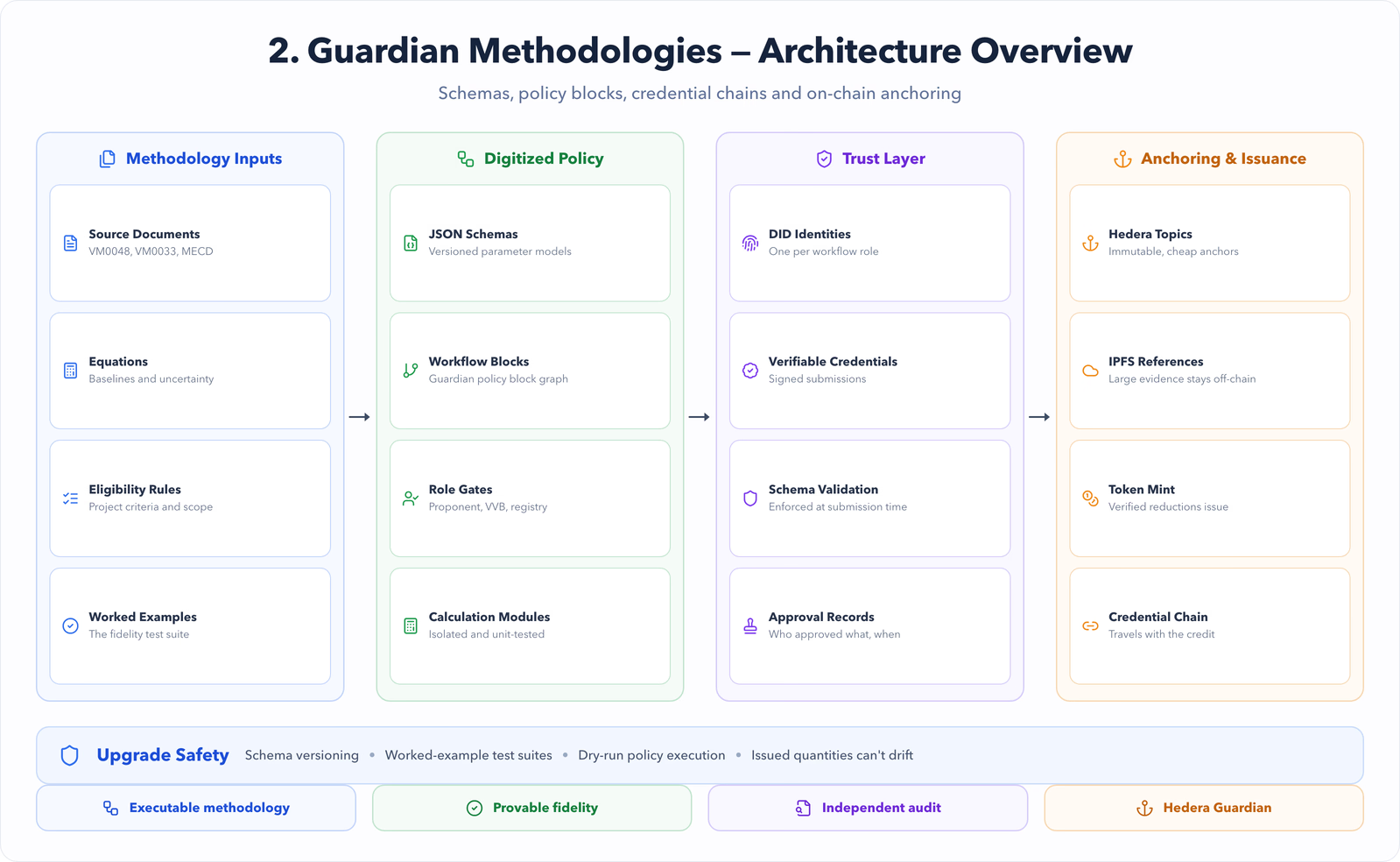
- Each methodology compiles to a Guardian policy: a graph of workflow blocks where documents flow between roles through schema-validated forms and approval gates.
- Monitoring data models are versioned JSON Schemas; submissions become verifiable credentials signed by the submitting role's DID.
- Calculation blocks derive baselines and emission reductions from credentialed inputs, so every number traces to signed source data.
- Artifacts and evidence anchor to Hedera topics (with large files referenced via IPFS), producing an immutable, independently checkable audit trail.
- Final verification triggers token minting — issued credits carry the full credential chain that justified them.
Key decisions
- Equations became isolated, unit-tested calculation modules validated against the methodologies' own worked examples — the only defensible proof of fidelity.
- Where a methodology requires expert judgment, the policy models an explicit human approval gate rather than pretending the judgment can be automated.
- Schema versioning from day one: monitoring requirements change, and in-flight projects must keep validating against the version they started under.
- Ambiguities discovered during digitization were documented and resolved with methodology stakeholders, not silently interpreted in code.
Implementation
- VM0048 policy flows cover project eligibility, deforestation baselines and leakage handling through role-gated submission and verification rounds.
- VM0033 flows model wetland restoration monitoring across carbon pools and reporting intervals, with schema-enforced parameter completeness.
- MECD flows digitize device deployment and usage monitoring with recurring monitoring-report cycles.
- Policies were exercised end-to-end in dry-run mode — registration through mint — before any real project data entered the system.
- Worked-example test suites pin calculation outputs so platform or policy upgrades can't silently change issued quantities.
Performance
- Large evidence files stay off-chain behind IPFS references; Hedera anchors stay small and cheap.
- Schema validation happens at submission time, so bad data fails fast at the edge instead of surfacing mid-verification.
- Batched anchoring keeps policy execution responsive during heavy submission periods.
Outcomes
- Three methodologies executable end-to-end: project registration through verified credit minting, with a complete credential chain behind every token.
- Calculation modules reproduce the methodologies' worked examples exactly — fidelity is demonstrated, not asserted.
- The digitized policies turn weeks of document-shuffling MRV into structured, auditable workflow.
- [PLACEHOLDER — add issued-credit volumes and program details when publishable.]
Lessons
- Methodology digitization is spec work: the methodology authors' intent is the spec, and every deviation must be visible.
- Digitizing a document exposes its ambiguities — resolving them with stakeholders is half the value delivered.
- In trust infrastructure, the audit trail is the product; the workflow is just how it gets built.
Software Architecture